
U.S. Sugar Processing Market Size, Share & Trends Analysis, 2032
Key Highlights
| Study Period | 2019 – 2032 |
| Market Size in 2024 | USD 12.5 Billion |
| Market Size in 2025 | USD 12.8 Billion |
| Market Size by 2032 | USD 16.4 Billion |
| Projected CAGR | 3.6% |
| Largest Region | South |
| Fastest Growing Region | Midwest |
| Market Structure | Consolidated |
Market Size
Major Companies
Important Takeaways
|
Explore the market potential with our data-driven report
U.S. Sugar Processing Market Future Outlook
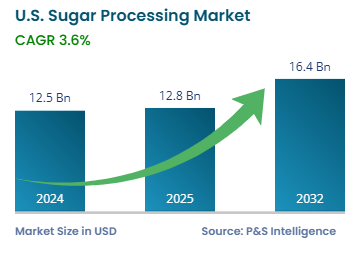
The U.S. sugar processing market size was USD 12.5 billion in 2024, and it will grow by 3.6% during 2025–2032, to reach USD 16.4 billion by 2032.
The market is driven by the increasing consumption of sugar-based products, growth in the beverage industry, impact of tariffs, and technological advancements with a focus on efficiency. All this is due to the increasing population, shifting tastes, rapid urbanization, surging disposable incomes, and changing dietary patterns. Despite health concerns, an average American adds almost 17 teaspoons of sugar to their meals every day, which is almost three times the recommended intake, says the American Heart Association.
U.S. Sugar Processing Market Segmentation Analysis
Product Type Analysis
The white category held the largest market share, of 75%, in 2024, because it is used in almost every kind of sweet food product. It is the principal sweetening ingredient in households, food manufacturing, and foodservice. Its neutral flavor allows it to be effectively used in a variety of products, such as bakery items, confectionery, dairy, and beverages.
The liquid category will grow at the highest CAGR of 4%, during the forecast period. This is because it dissolves instantly, unlike granulated sugar, and does not require heating or mixing for further processing, saving time and energy. Therefore, it is especially appealing to soft drink producers, bakers, and dairy processors focused on efficiency and uniformity. Its adoption is further escalating due to the increasing demand for ready-to-drink (RTD) beverages, flavored milk, and processed foods.
The product types analyzed in this report are:
- White (Largest Category)
- Brown
- Liquid (Fastest-Growing Category)
Form Analysis
The granulated category held the largest market share, of 70%, in 2024. Being dry and free-flowing, with a good shelf life, granulated sugars are widely used for baking, cooking, and sweetening drinks. They are considered pantry essentials for consumers and a fundamental ingredient in industrial food production. Due to the consistent quality and ease of bulk handling, bakeries, cereal manufacturers, and snack producers, heavily rely on this variant.
The syrup category will grow at the highest CAGR, of 4.5%, during the forecast period. Syrup has high solubility, making it highly effective for the bulk production of soft drinks, flavored waters, dairy products, and condiments. Beverage manufacturers prefer liquid sugar because it integrates into the production line, thereby reducing processing time and energy consumption.
The forms analyzed in this report are:
- Granulated (Largest Category)
- Powdered
- Syrup (Fastest-Growing Category)
- Cube
Source Analysis
The sugarcane category held the largest market share, of 55%, in 2024, because sugarcanes have a higher inherent sugar content, making them a more-efficient and economical source for sugar production on a per-unit basis. Additionally, the widespread global cultivation of sugarcane in tropical and subtropical regions ensures a consistently high supply.
The sugar beet category will grow at the highest CAGR, of 4.8%, during the forecast period. This because of the changes in farming technology, including tougher beet varieties for northern states, where sugarcane cannot be cultivated. Sugar beet has a shorter growing cycle, which allows for local and efficient processing near farms, driving down logistics costs and enhancing the supply chain efficiency. Additionally, new seed technologies and sustainable farming practices make sugar beets more beneficial for farmers.
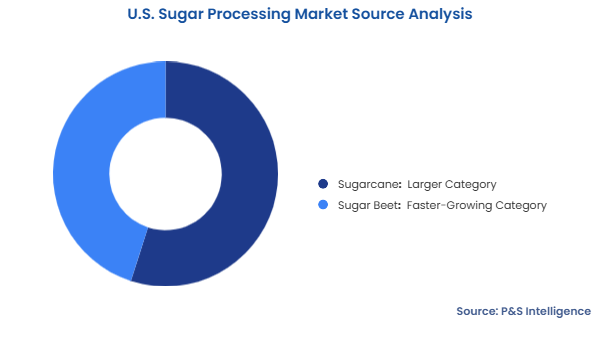
The sources analyzed in this report are:
- Sugarcane (Larger Category)
- Sugar Beet (Faster-Growing Category)
End Use Analysis
The food & beverages category held the largest market share, of 40%, in 2024. This is because sugar is irreplaceable as a natural sweetener, preservative, and texturizer in countless products. The bakery and confectionery industry is a massive consumer of sugar, as it is essential in cakes, cookies, candies, and chocolates.
The pharmaceuticals category will grow at the highest CAGR, of 5%, during the forecast period. This is because of sugar’s functional role as a binding agent, sweetener, and stabilizer in syrups, probiotics, chewable tablets, and gummy vitamins. Sugar improves taste, thereby increasing patient compliance, particularly in pediatric and geriatric populations.
The end uses analyzed in this report are:
- Food & Beverages (Largest Category)
- Confectionary
- Bakery Products
- Dairy Products
- Beverages
- Others
- Pharmaceuticals (Fastest-Growing Category)
- Personal Care
- Household
Drive strategic growth with comprehensive market analysis
U.S. Sugar Processing Market Regional Outlook
The South category held the largest market share, of 40%, in 2024, because of suitable conditions for agriculture and climate for growing sugarcane. Florida, Louisiana, and Texas have a long history of sugarcane farming because of fertile soil, plenty of rain, and extended growing seasons. The region has a well-developed infrastructure, including large-scale sugar mills and refineries operating for many years.
The Midwest category will grow at the highest CAGR of 3.8%, during the forecast period. This is because the states of Minnesota, North Dakota, and Idaho have temperate and favorable weather, which is highly suitable for sugar beet cultivation. Additionally, genetically modified beet varieties and precision farming technology aim to maximize yield and efficiency. Strong cooperative arrangements, where farmers collectively own processing facilities, encourage innovation and investment in modernized refineries.
The geographical breakdown of the market is as follows:
- Northeast
- West
- Midwest (Fastest-Growing Category)
- South (Largest Category)
U.S. Sugar Processing Market Competitive Landscape
The market is consolidated because a few major players hold a combined major share. This is because the sugar refining and processing industry is highly capital-intensive, requiring high investments in infrastructure, technology, and strict adherence to federal regulations. American Sugar Refining, Inc., Tereos Group, Cosa, and Associated British Flood dominate production, while the major corporations and cooperatives benefit from economies of scale, enabling them to maintain efficiency and price competitiveness.
Key U.S. Sugar Processing Companies:
- Cargill,Inc.
- American Crystal Sugar
- Michigan Sugar Company
- Tereos
- Cosan
- Texon International Group
- united states sugar corporation
- Florida Crystals Corporation
- Imperial Sugar Company
- Western Sugar Cooperative
- Amalgamated Sugar Company
- Southern Minnesota Beet Sugar Cooperative
link


