Bandwidth, Budget, Buy-In: Skilled Nursing Tech Investment Depends on Tricky Balance

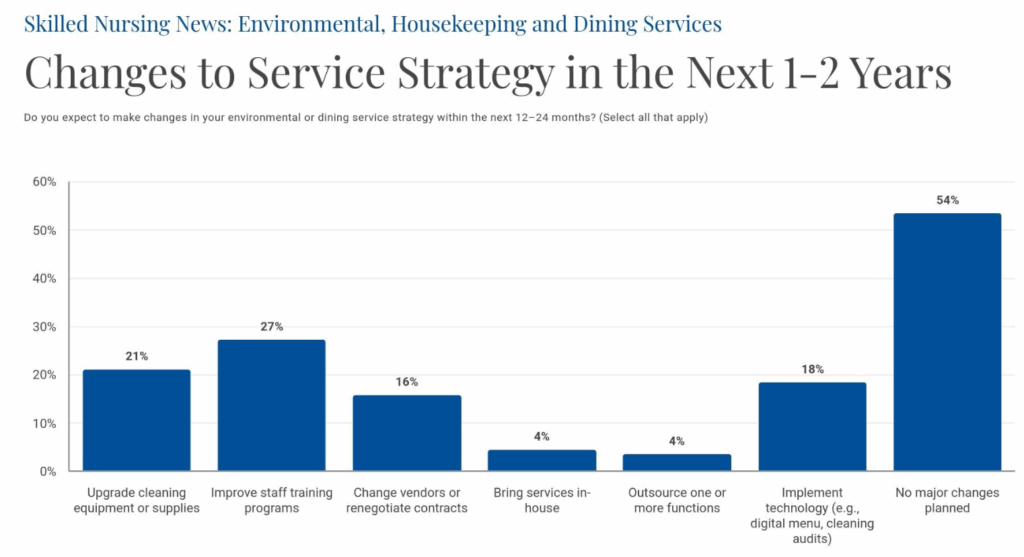
When it comes to dining and environmental services, skilled nursing leaders believe that technology can help their organizations achieve some key goals. However, 54% of respondents to a recent Skilled Nursing News survey said they have no major changes planned when it comes to service strategy over the next one to two years.
That was the most common answer, followed by improving staff training programs at 27% and then upgrading cleaning equipment or supplies at 21%. The survey captured responses from 115 people employed by skilled nursing provider companies, 54% of whom are in a corporate executive/leadership role.
Improving quality is something nearly all operators are driving forward; technology initiatives tied to these areas obviously require some changes, Jason LeCroy, SVP of business development for Healthcare Services Group, said on a webinar discussing the survey findings.
“I think deep down, based on other answers to the survey, they mean to change. They’re just not sure what they want to change,” said LeCroy.
LeCroy and leaders with two operators – Ignite Medical Resorts and Journey Skilled Nursing – stressed that successful technology adoption depends on strong vendor partnerships and alignment on strategic goals. A new technology must move multiple priorities forward, notably resident experience, staff engagement, budget efficiency and compliance.
Intersection of technology and quality
Implementing technology such as digital menus or cleaning audits also is among the changes that some providers are pursuing, but only 18% of survey respondents said they are targeting this type of initiative within the next two years.
Still, the webinar panelists agreed that technology investment is critical to driving operational efficiency and better outcomes.
While nursing homes will always be a person-to-person business, Journey COO Matthew Trammell said that technology allows the flexibility and freedom to move resources where they’re needed most.
“Technologies outside of that person-to-person contact is where we’ll gain the most ground and flexibility to further engage with our residents,” added Trammell.
LeCroy expects tech to be tied to quality, with operators striving to provide a better experience by leveraging technology.
“AI can be really supportive with recruiting, staffing and training – that can be huge. AI works around resident choice with the food menu, recipes, dining choice … AI can help dictate different preferences for the residents,” said LeCroy.
Ignite leadership is considering demos of new technologies all the time, Ignite Chief Culture Officer Jim White said.
“We are looking for smart ways to integrate AI into different areas of the company, including dining services. We have an automated floor cleaner that we are piloting in one of our buildings to see how it might impact the operation,” White said of Ignite’s pilot technologies.
If operators are evaluating tools to aid in housekeeping and dining services, they tend to focus on digital meal ordering and resident-facing menus, SNN’s survey found, followed by food temperature tracking technology at 22% and 20%, respectively.

Yet, 51% said they aren’t evaluating such tools currently and 18% aren’t sure where to start. This could be attributed to the usual slim margins known in the sector, leaving resources for investment on the backburner. It’s also about company bandwidth too, with a finite amount of time and people power to integrate an investment into day-to-day operations.
Ignite has focused on getting labels and dating for food preparation back where it needs to be; it’s something that “suffers more than anything else,” White said. Lapses also lead to one of the easiest citations to write, when food isn’t properly labeled and dated.
A Bluetooth thermometer model is being tested, to ensure temperatures are being logged properly.
Both Journey and Ignite turned to robotic floor cleaning at their facilities, and next on the list will be automated cleaning logs, the executives with these companies said.
“That’s a no brainer. It makes sense, any time we can get rid of paper and move to more digital solutions,” said Trammell. “Digital meal ordering is a little bit further off for us. It really comes down to bandwidth … the struggle is real.”
For LeCroy, HSG must be the “tip of the spear” when it comes to the best tech, the best options and best way to provide those options for a great resident experience and consistent staff, all within budgetary constraints.
“We can bring those solutions in a packaged environment … to be able to continue to vet those investors’ intellectual capital, invest our financial capital and bring the best solutions to our partners to free up the bandwidth so they can focus on other things,” said LeCroy.
Deciding on tech investments
Reasoning for adding more technology to environmental, housekeeping and dining services aligns with LeCroy’s thoughts: 66% of respondents said tech was added to these areas to increase resident satisfaction, followed by 51% citing improved regulatory compliance.

Only 38% of operators said tech investments were meant to reduce staff burdens, while 37% said lower operating costs was a factor in tech investments. About 33% of operators said reduced risk of infection and improved safety was driving tech investment, and 30% said operational efficiency and tracking was a huge incentive.
Only 12% said greater consistency and standardization across programs was driving their tech investments.
For Ignite, reduced staff burden and increased satisfaction for residents are their two biggest drivers for implementing tech in dining and housekeeping, but there’s more nuance here.
“Consistency and standardization as [an] incentive touches all of the other perceived benefits of technology investment,” White said. “Not only that, it drives accountability.”
But change is really hard, Trammell noted, especially if staff are doing really well with the current status quo and have found their ebb and flow.
“I think that, by and large, the right technologies can make it more efficient, but you’re always going to have that group that will be kicking and screaming … you work with them to get them into the next phase of technology and to create that change and an adoption,” Trammell said of tech adoption.
For LeCroy, if a technology moves several major “buckets” forward, then it’s worth it. Resident satisfaction, employee engagement and satisfaction, budgetary efficiency and regulatory compliance must be progressed through a newly introduced technology, he said.
When it comes to choosing a vendor for various technologies, Trammell said that it all starts with a good partnership and aligned strategies before there’s discussion of cost efficiencies.
“Every once in a while at the end of that conversation, the cost just doesn’t match. But I find that to be rare,” Trammell said.
LeCroy echoed Trammell’s thoughts on vendor relationships from the other side of the table, saying that partnership is priority No. 1was number one, and quality outcomes is No. 2number two when choosing a vendor, while cost efficiency is expected.
“Cost is important, but I don’t see it at the detriment of relationships or quality,” added LeCroy.
link