City council approves 2026 budget with focus on ‘strategic investment’
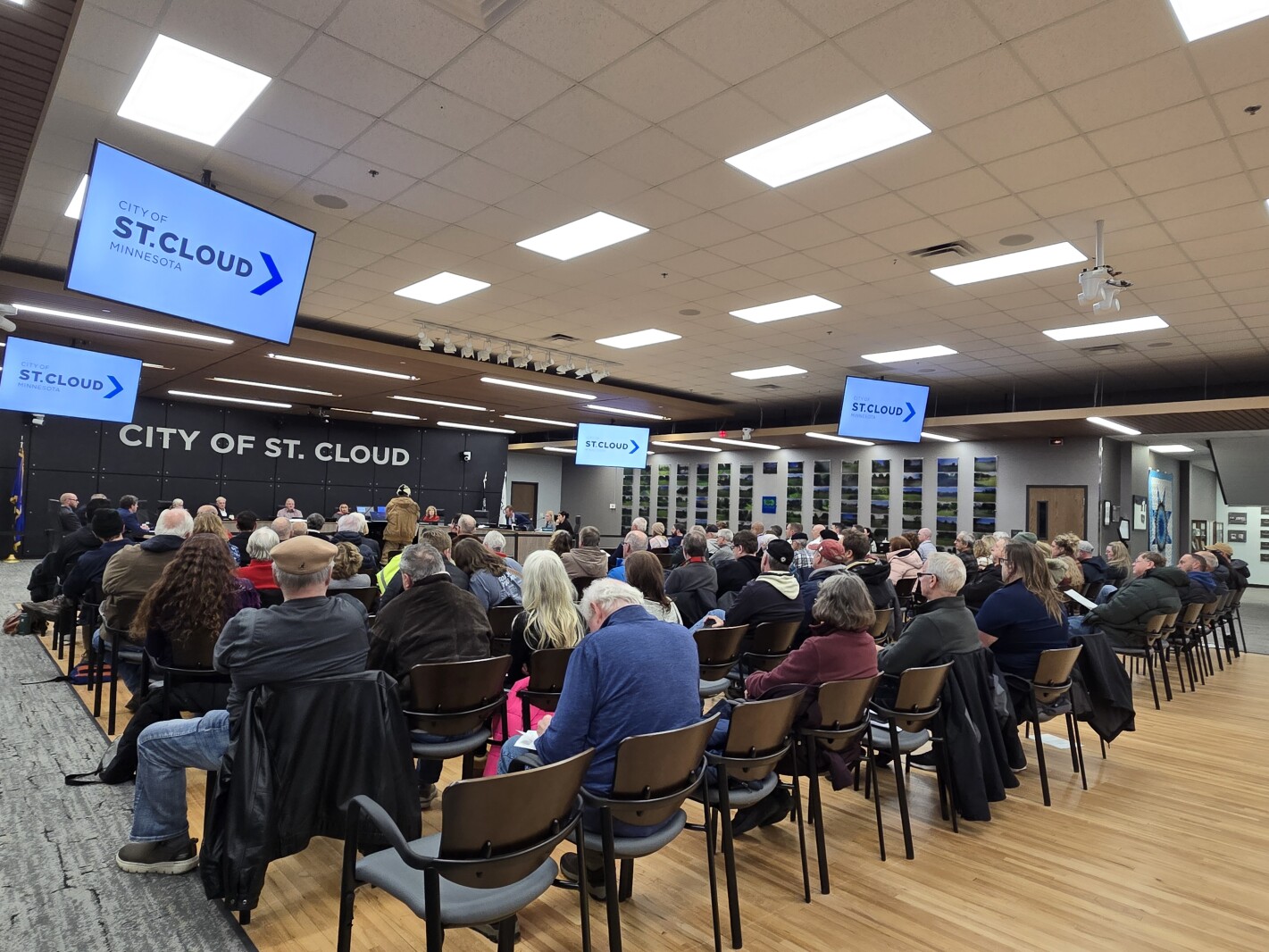
ST. CLOUD — Residents were anxious to make their voices heard during a public hearing on the 2026 governmental funds budget, which includes a 4.49% property tax increase, at a Monday, Dec. 1, St. Cloud City Council meeting.
After a two-hour hearing inside a full City Hall Chambers, the St. Cloud City Council voted unanimously to pass the first budget under Mayor Jake Anderson, who replaced long-time mayor
Dave Kleis.
The budget totals about $100.8 million, or a 12.29% increase from last year. Scott Brodeen, who
previously voted
against the budget proposal, was the lone council member absent from Monday night’s meeting.
Anderson said the increase comes as the city faces a plethora of outdated equipment in dire need of upgrades, inflation, voter-approved referendums (which make up about 71% of the increase), and staff hiring, such as an arborist, a human resources manager, a building inspector and an environmental health specialist.
“I just want to be clear, our budget submittal, what I’m submitting to you today, reflects the strategic priorities and focus areas of the city,” Anderson said. “It’s a very difficult budget to put together. The goal is to always, in my opinion, keep it flat.”

Lauren Breunig / St. Cloud LIVE
The vision for the budget, according to Anderson, is to create financial sustainability, foster exceptional customer service, enhance livability, public safety and efficiencies to start filling holes left by the “capture the growth” philosophy implemented by Kleis, who served as mayor for 20 years. Roughly 58% of the city’s equipment and vehicles valued over $50,000 are at least a year overdue for upgrades, repairs or replacement.
“I’m not going to disparage any past practice, but these problems could’ve been solved a lot easier over the years,” Anderson said, adding that the city faces a $3.2 million shortfall.
If no action were taken, the city would be forced to cut programs, staffing and other services for police, fire and street maintenance, Anderson said.
“I was surprised to hear that we were inheriting a $3.2 million deficit,” Council member Mark Johnson, who was elected in 2024, said. “And yes, we’ve kind of inherited a city with a leaky roof. Nobody likes to put money into that kind of thing, but if we don’t, the costs are just going to go higher.”
Nearly two dozen speakers stood at the dais to address the six council members, with some highlighting their concerns about facing already rising prices from inflation to medical insurance, and now receiving increased property taxes. At times, the crowd broke out in applause after speakers addressed the council.
Elizabeth Kirchoff, a St. Cloud resident, said she received a 26% increase in property tax valuation.
“I cannot afford this, it’s a great wish list, I have a great wish list, too,” Kirchoff said. “You are squeezing me out of my home and out of this town.”
Another resident, Thomas Schonfelder, was part of a protest crowd in front of City Hall before the meeting and called the situation “unfortunate,” as the city faces a backlog of overdue vehicle repairs and infrastructure.
“This is a gouge; it’s a gouge to me,” Schonfelder told the council.
Some residents also addressed the council and Anderson to ask if an increase such as this should be considered the “baseline” or if they’ll go back down in the future. Anderson said that’s a “complicated question,” as the city doesn’t know what future economic development will bring. He said the city will focus on realigning its economic development message in 2026 and beyond to attract industries to the area.
While there were many residents against the proposed budget, there were some supporters, including Suzanna Moore, who’s new to St. Cloud, who said she was in favor of the increase and “wants more services.”
Another resident, Roy Reynolds, voiced his concerns but acknowledged the financial circumstances the city faces.
“It sounds like, other people have said it, your predecessors have really left you in a hard position, so I hope you can go through and get us back on track again,” Reynolds said.
Council member Karen Larson noted Anderson’s efforts, too.
“I see a new mayor who cannot be held responsible for the actions of his predecessor, a new mayor who needs a chance to make adjustments to the city course, a new mayor who is bravely going after fiscal stability for the city, it’s not easy, because of this context that it’s happening,” Larson said. “I appreciate all of that. Those deferred issues still have to be dealt with; he’s absolutely right on that front.
“By the same token, however, I’m looking at what we may gain in fiscal stability, we may lose in citizen goodwill because of the overall context that’s trying to pull us apart,” Larson added.
Fifty-nine percent of the governmental funds budget is coming from property taxes, according to the city.
- Personnel services: $62,599,900
- Supplies: $4,785,100
- Services and Charges: $8,762,000
- Capital Outlay: $249,600
- Debt Service: $13,797,200
- Transfers: $5,105,000
- Remittance of Revenue: $1,869,400
- Reserves: $3,702,800
Total: $100,844,000
The budget in its entirety can be viewed at
ci.stcloud.mn.us/DocumentCenter/View/29485/2026-Governmental-Funds-Budget.
Enterprise Funds Budget approved
The city council also approved the 2026 enterprise funds budget, which covers utilities for water, wastewater, hydroelectric, storm water, street light, the parking system, refuse service and city facilities, including the Municipal Athletic Complex and the River’s Edge Convention Center.
The water rates will reflect a monthly increase of about $4 for households using 6,000 gallons a month and only about 8% use more than that, Anderson previously said. All increases, save for the water rate changes, are optional.
A breakdown of the enterprise funds budget is:
- Water utility: $17,475,800
- Wastewater utility: $22,278,500
- Hydroelectric utility: $1,920,000
- Storm water utility: $3,113,700
- Street light utility: $2,280,700
- Parking system: $1,896,100
- Refuse system: $5,937,500
- Municipal Athletic Complex: $6,249,200
- River’s Edge Convention Center: $4,630,800
Total: $65,782,300.
- The St. Cloud City Council passed several ordinance amendments, including one to traffic and parking regulations that will hike downtown parking fees to $1.50 – up from $1, implement free parking lots and ramps after 5 p.m. and on weekends, increase parking permit rates by 10% and raise parking fees from $15 to $20 and increase late fees.
- The council also passed an amendment to the refuse, recycling and yard waste collection ordinance to: increase 95-gallon trash cart fees by $1; increase compost permit fees $10 for residents and $20 for non-residents; and add a $5 increase to special pickups and mattress disposals.
- Council members also approved a bridge replacement priority list with the Heatherwood Road bridge, crossing Johnson Creek, as the top and only choice. The project, proposed for 2027, is expected to cost $1.46 million and will use $292,000 in local or state aid funds.
- Liquor license violation stipulations also were passed. Howie’s Sports Bar & Grill,
Stihl Wolf
and Southtown Liquor all failed compliance checks. Howie’s and Stihl Wolf will pay a $750 civil penalty for their first violation, while Southtown Liquor will pay $1,500 for its second violation in the past 24 months.
The St. Cloud City Council will next meet on Dec. 15, 6 p.m., at St. Cloud City Hall, 1201 Seventh St. S.
link