
Peracetic Acid and Alternative Disinfectants Market | Global Market Analysis Report
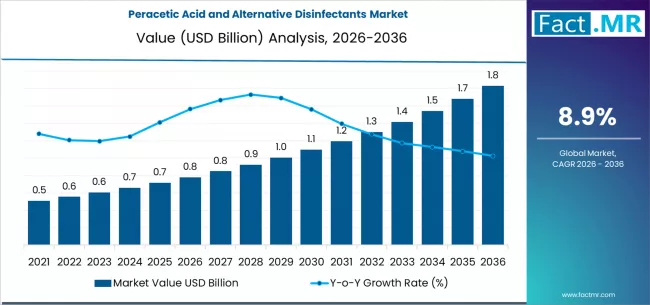
Peracetic Acid and Alternative Disinfectants Market Forecast and Outlook 2026 to 2036
The global market for peracetic acid and alternative disinfectants is experiencing significant expansion, driven by a broad shift away from traditional chlorine-based chemistries toward more effective and environmentally compatible solutions. Projected to grow from USD 0.78 billion in 2026 to USD 1.83 billion by 2036, the market is set to advance at a CAGR of 8.9% over the forecast decade.
Key Takeaways from the Peracetic Acid and Alternative Disinfectants Market
- Market Value for 2026: USD 0.78 Billion
- Market Value for 2036: USD 1.83 Billion
- Forecast CAGR (2026-2036): 8.9%
- Leading Disinfectant Type Share (2026): Peracetic Acid (PAA) (34%)
- Leading Application Area Share (2026): Municipal Water & Wastewater (32%)
- Leading Delivery Form Share (2026): Liquid Dosing Solutions (42%)
- Key Players in the Market: Solvay, Evonik, Kemira, Ecolab, PeroxyChem (Evonik)
Peracetic acid (PAA) stands as the dominant disinfectant type, commanding a 34% market share. Municipal water and wastewater treatment represents the largest application area, accounting for 32% of demand. Liquid dosing solutions are the preferred delivery form, with a 42% share, reflecting the need for precise, automatable integration into industrial and municipal treatment processes.
This growth is fueled by increasingly stringent regulations governing disinfection byproducts (DBPs), residual toxicity, and environmental discharge. Peracetic acid and its alternatives offer powerful, broad-spectrum microbial control without forming persistent halogenated byproducts, making them critical for applications where water reuse, environmental protection, and final product safety are paramount. Their rapid decomposition into harmless residues addresses both regulatory compliance and sustainability objectives across diverse sectors.
Market innovation focuses on enhancing formulation stability, improving handling safety, and developing synergistic blends that boost efficacy while lowering overall chemical consumption. The advancement of these technologies is essential for meeting modern disinfection challenges that demand high performance without compromising ecological or public health.
Metric
| Metric | Value |
|---|---|
| Market Value (2026) | USD 0.78 Billion |
| Market Forecast Value (2036) | USD 1.83 Billion |
| Forecast CAGR (2026-2036) | 8.9% |
Category
| Category | Segments |
|---|---|
| Disinfectant Type | Peracetic Acid (PAA), Hydrogen Peroxide-Based Blends, Ozone & Advanced Oxidation Agents, Chlorine Alternatives (Chlorine-Free), Other Eco-Friendly Disinfectants |
| Application Area | Municipal Water & Wastewater, Food & Beverage Processing, Healthcare & Sanitation, Pulp & Paper/Industrial Water, Agriculture & Aquaculture |
| Delivery Form | Liquid Dosing Solutions, Stabilized Concentrates, Tablet/Powder Formulations, Encapsulated/Controlled Release, Other Specialty Formats |
| Region | North America, Latin America, Western Europe, Eastern Europe, East Asia, South Asia & Pacific, MEA |
Segmental Analysis
By Disinfectant Type, Which Chemistry Offers a Balanced Profile of Efficacy and Safety?
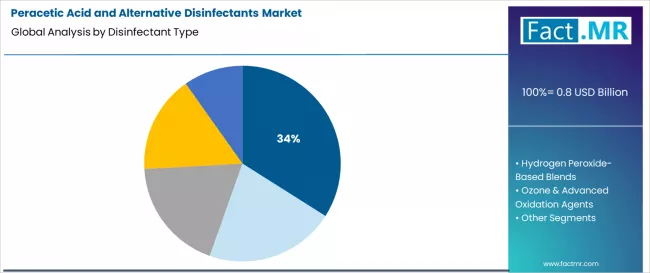
Peracetic acid leads the market with a 34% share. Its dominance stems from an optimal combination of potent oxidizing power and a favorable environmental profile. PAA is effective against a wide spectrum of pathogens, including bacteria, viruses, and spores, even in the presence of organic matter.
Peracetic acid decomposes into acetic acid and oxygen, leaving no persistent toxic residues or forming regulated halogenated DBPs. This balance makes it a versatile choice for applications ranging from wastewater disinfection to food surface sanitization.
By Application Area, Where is the Regulatory Push Away from Chlorine Strongest?
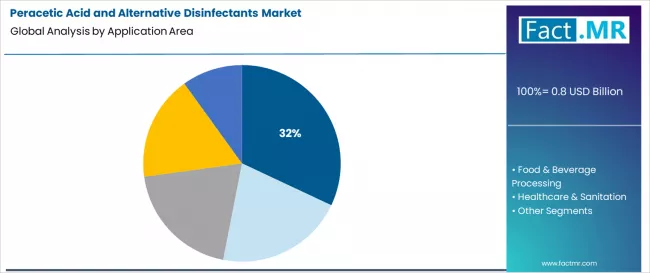
Municipal water and wastewater treatment represents the largest application area, holding a 32% share. Stringent regulations on chlorine residual and DBP formation in effluent are compelling utilities to seek alternative disinfectants.
PAA and advanced oxidation processes (AOPs) provide effective tertiary disinfection for reuse projects and safe discharge without the environmental burden of chlorinated compounds, making them increasingly integral to modern wastewater treatment plant design and upgrades.
By Delivery Form, Which Method Enables Precision and Integration?
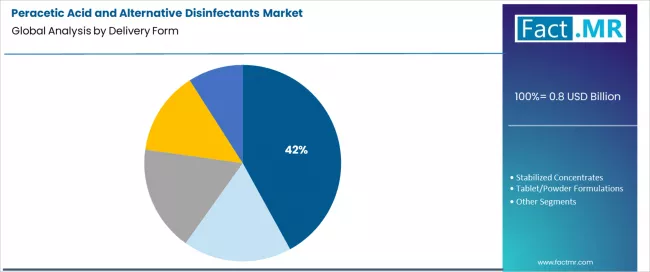
Liquid dosing solutions are the leading delivery form, commanding a 42% share. The effective use of alternative disinfectants like PAA often requires precise control over concentration and contact time. Automated liquid dosing systems integrate seamlessly with process control networks, allowing for real-time adjustment based on flow, demand, or pathogen load. This precision ensures optimal efficacy, maximizes cost-efficiency, and minimizes the risk of under- or over-dosing, which is critical in sensitive applications like food processing and potable reuse.
What are the Drivers, Restraints, and Key Trends of the Peracetic Acid and Alternative Disinfectants Market?
The primary market driver is the global regulatory phase-out and restriction of chlorine-based disinfectants due to concerns over DBPs, residual toxicity, and the formation of persistent organic pollutants. The growth of water reuse mandates also requires disinfectants that do not compromise the safety or acceptability of recycled water. Furthermore, industries like food and beverage are adopting these alternatives to meet consumer demand for cleaner labels and to eliminate chlorine taint from products, linking operational hygiene with brand reputation.
A significant market restraint is the higher unit cost of some alternatives, particularly stabilized PAA formulations, compared to commodity chlorine. Some alternatives, like ozone, require significant capital investment in on-site generation equipment. Handling and storage can also pose challenges; PAA, for instance, is corrosive and requires careful material selection and safety protocols. A lack of familiarity with the application protocols for these newer technologies can also slow adoption in conservative industries.
Key trends include the development of stabilized and blended formulations that enhance the shelf-life and handling safety of PAA while maintaining its efficacy. There is growing integration of advanced oxidation processes that combine ozone, hydrogen peroxide, and UV light for synergistic, chemical-free disinfection in sensitive applications. The market is also moving toward on-site electrochemical generation of PAA and other oxidants, which reduces transportation and storage hazards and allows for precise, just-in-time production.
Analysis of the Peracetic Acid and Alternative Disinfectants Market by Key Countries
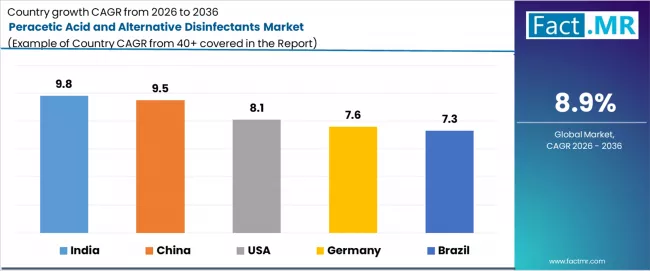
| Country | CAGR (2026-2036) |
|---|---|
| India | 9.80% |
| China | 9.50% |
| USA | 8.10% |
| Germany | 7.60% |
| Brazil | 7.30% |
How do India’s Water Reuse Ambitions and Industrial Growth Drive Adoption?
India’s leading CAGR of 9.80% is driven by its national focus on water conservation and stringent new standards for industrial effluent discharge. Regulations pushing for zero-liquid discharge and the reuse of treated wastewater are creating a major market for disinfectants that leave no harmful residuals.
The expansion of food processing and pharmaceutical manufacturing further fuels demand for PAA and hydrogen peroxide blends as safe, effective sanitizers that meet international export and safety standards.
What is the Impact of China’s Environmental Regulations and Food Safety Modernization?
China’s 9.50% growth is linked to its continued enforcement of the Water Ten Plan and parallel upgrades in food safety protocols. The mandate to reduce chemical oxygen demand and toxicity in wastewater favors disinfectants like PAA that have a low environmental impact. In the food sector, the move toward higher hygiene standards to serve both domestic and export markets is accelerating the replacement of chlorine with more advanced, residue-free disinfectants.
How does the USA’s Regulatory Landscape and Focus on PFAS Influence the Shift?
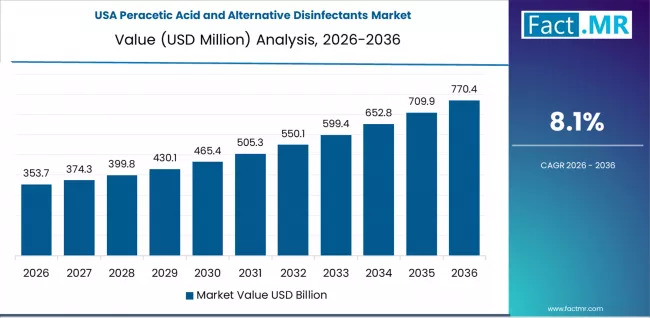
The USA’s 8.10% CAGR is supported by regulations limiting chlorine use in wastewater discharge and growing concerns over PFAS contamination, as some alternative disinfectants do not contribute to this problem.
The strong focus on water reuse in arid states and the food industry’s proactive adoption of greener chemistries drive steady demand. The market is characterized by a preference for proven, EPA-registered alternative disinfectants with robust technical support.
Why is Germany a Key Market for Advanced and Sustainable Treatment Technologies?
Germany’s 7.60% growth reflects its strict implementation of EU water directives and a deep commitment to green chemistry. German industries and municipalities seek disinfectants that combine high efficacy with a flawless environmental profile.
This drives innovation and adoption of PAA and ozone/UV AOPs, particularly in sensitive applications like municipal wastewater treatment for direct discharge into ecologically vulnerable waters and in food production under organic certification schemes.
What Role does Brazil’s Agri-Industrial and Sanitation Sectors Play?
Brazil’s 7.30% growth is anchored in its massive agri-industrial sector and expanding urban sanitation projects. PAA and hydrogen peroxide blends are increasingly used in poultry, meat, and fruit processing for export compliance.
Investments in new wastewater treatment infrastructure to improve sanitation coverage are creating opportunities for alternative disinfection technologies that are effective in tropical climates and suitable for reuse in agriculture.
Competitive Landscape of the Peracetic Acid and Alternative Disinfectants Market
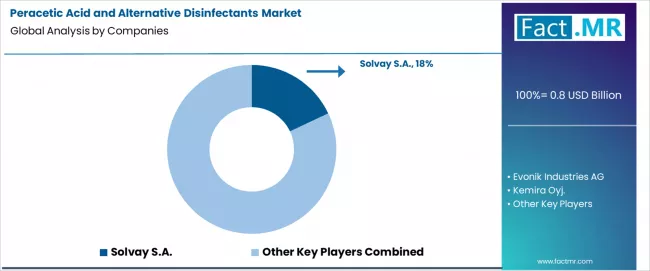
The competitive landscape features global chemical companies with strong positions in peroxygen and specialty chemical manufacturing. Leaders like Solvay and Evonik compete based on their integrated production of key precursors (acetic acid, hydrogen peroxide), formulation expertise, and global supply chains.
Competition centers on providing high-purity, stable products, comprehensive technical application support, and tailored blending services. A key differentiator is the ability to offer a complete disinfection solution that includes dosing equipment, monitoring technology, and regulatory compliance assistance, moving beyond chemical supply to a full-service model.
Key Players in the Peracetic Acid and Alternative Disinfectants Market
- Solvay S.A.
- Evonik Industries AG
- Kemira Oyj.
- Ecolab
- PeroxyChem (Evonik)
Market by Segments
-
Disinfectant Type :
- Peracetic Acid (PAA)
- Hydrogen Peroxide-Based Blends
- Ozone & Advanced Oxidation Agents
- Chlorine Alternatives (Chlorine-Free)
- Other Eco-Friendly Disinfectants
-
Application Area :
- Municipal Water & Wastewater
- Food & Beverage Processing
- Healthcare & Sanitation
- Pulp & Paper/Industrial Water
- Agriculture & Aquaculture
-
Delivery Form :
- Liquid Dosing Solutions
- Stabilized Concentrates
- Tablet/Powder Formulations
- Encapsulated/Controlled Release
- Other Specialty Formats
-
Region :
-
North America
-
Latin America
- Brazil
- Mexico
- Argentina
- Rest of Latin America
-
Western Europe
- Germany
- UK
- France
- Spain
- Italy
- BENELUX
- Rest of Western Europe
-
Eastern Europe
- Russia
- Poland
- Czech Republic
- Rest of Eastern Europe
-
East Asia
- China
- Japan
- South Korea
- Rest of East Asia
-
South Asia & Pacific
- India
- ASEAN
- Australia
- Rest of South Asia & Pacific
-
MEA
- Saudi Arabia
- UAE
- Turkiye
- Rest of MEA
-
link


