
U.S. Colocation Market Size, Share & Trends Analysis, 2032
Key Highlights
| Study Period | 2019 – 2032 |
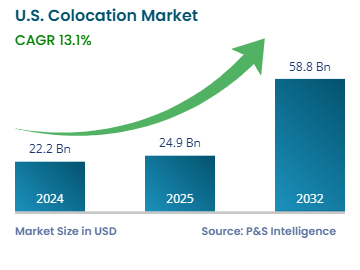
| Market Size in 2024 | USD 22.2 billion |
| Market Size in 2025 | USD 24.9 billion |
| Market Size by 2032 | USD 58.8 billion |
| Projected CAGR | 13.1% |
| Largest Region | Northeast |
| Fastest Growing Region | Midwest |
| Market Structure | Fragmented |
Market Size
Major Companies
Important Takeaways
|
Explore the market potential with our data-driven report
U.S. Colocation Market Overview
The U.S. colocation market valued at USD 22.2 billion in 2024 and is estimated to grow at a CAGR of 13.1% to expand to USD 58.8 billion in 2032. The market is driven by the generation of large amounts of data and the rapid application of data analysis to increase business efficiency.
Essentially, due to the rising adoption of IoT and cloud computing, the amount of data generated is huge, to store which businesses must invest significantly in IT infrastructure. Cost optimization is the top priority for any business, and colocation helps greatly in this regard, offering scalable storage and predictable pricing, along with cost reduction. The data colocation model allows companies to rent bandwidth and space at a data center to house its IT hardware, including servers.
The market is now witnessing the trend of green data centers, which use renewable energy, alongside energy-efficient solutions, such as ENERGY STAR-rated HVAC systems and waste heat recovery apparatus. The industry faces pressure from regulatory agencies along with a heightening consumer demand for businesses to follow ESG principles.
U.S. Colocation Market Segmentation Analysis
Type Insights
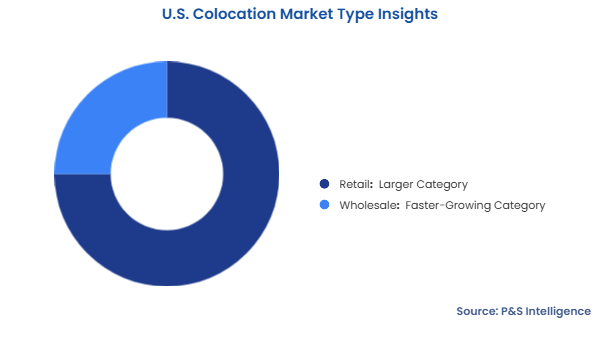
Retail is the larger category, holding market share of around 75% in 2024. Huge numbers of SMEs and startups choose retail colocation due to the availability of flexible plans and customizable solutions in well-connected urban areas. Scalability and affordability make retail colocation a preferred solution among businesses that cannot afford to spend too much on any one department. Retail colocation is also desirable because operations can scale while enjoying robust security benefits.
Types studied in the report:
- Retail (Larger Category)
- Wholesale (Faster-Growing Category)
Organization Insights
The large enterprises category leads the market as these organizations extensively employ colocation services to obtain a high storage capacity, security, scalability, and flexibility of access. Through data centers as a service (DCaaS), large businesses can store and process massive information volumes, to achieve operational continuity and regulatory compliance. As per Veritas Technology LLC, an average large enterprise in the U.S. stores around 10 Petabytes of data.
SMEs are witnessing the higher CAGR, of approx. 12.7%, as their digital transformation is leading to an increasing volume of data. However, their financial incapability prevents them from spending on expensive IT hardware for onsite installation. On the other hand, they are not also in a position to pay for damages in case of data breaches at a public data center. Both these dilemmas impel these companies to host their data at a colocation facility.
Organizations taken under study:
- Small and Medium Enterprises (Faster-Growing Category)
- Large Enterprises (Larger Category)
Vertical Insights
The IT & telecom category holds the market share of around 30% in 2024. This is because this sector depends on efficient data storage, processing, and connectivity to support telecommunications networks and data-driven technologies. The fast-growing adoption of cloud computing, 5G, and IoT and the abundant data traffic within IT & telecom companies drive the requirement for secure and scalable colocation facilities.
Healthcare is the fastest-growing vertical due to the digital health initiatives prevalent around the country. Health centers had already begun to digitize their record-keeping and charting activities in the beginning of the previous decade, and the COVID-19 pandemic put it into overdrive. The resulting trends of remote patient monitoring, teleconsultations, mHealth apps, and wearable fitness trackers continue to compound data storage challenges for the healthcare sector. This is why health systems around the country are looking at colocation facilities to store their data securely and cost-effectively.
Verticals covered in the report:
- BFSI
- Healthcare (Fastest-Growing Category)
- Energy and Utility
- IT & Telecom (Largest Category)
- Retail & E-commerce
- Manufacturing
- Government & Public Sector
- Media & Entertainment
- Others
Drive strategic growth with comprehensive market analysis
U.S. Colocation Market Regional Outlook
The Northeast region dominates the market with 40% share in 2024 because it contains numerous financial institutions and technology corporations, which generate massive amounts of data. The Northeast region attracts colocation service providers with its next-generation telecommunications networks and easy access to renewable energy resources. Even the tech-savvy individuals in this region have started seeking colocation solutions for their substantial amounts of digital information.
Regions covered in the report:
- Northeast (Largest Region)
- Midwest (Fastest-Growing Region)
- West
- South
link


