
U.S. Social Networking Market Size, Share & Trends Analysis, 2032
Key Highlights
| Study Period | 2019 – 2032 |
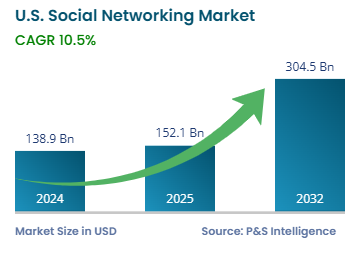
| Market Size in 2024 | USD 138.9 Billion |
| Market Size in 2025 | USD 152.1 Billion |
| Market Size by 2032 | USD 304.5 Billion |
| Projected CAGR | 10.5% |
| Largest Region | South |
| Fastest Growing Region | South |
| Market Structure | Consolidated |
Market Size
Major Companies
Important Takeaways
|
Explore the market potential with our data-driven report
U.S. Social Networking Market Overview
The U.S. social networking market size stood at USD 138.9 billion in 2024, and it is expected to grow at a CAGR of 10.5% during 2025–2032, to reach USD 304.5 billion by 2032.
People in the country are increasingly incorporating social media into their everyday routines. Users throughout the market choose to connect through four leading platforms such as Facebook, Instagram, Twitter, and LinkedIn which provide different ways to share and interact with their content and connect with people around the world. Advertisements that match individual user preferences drive most of the market earnings through data-driven advertising methods. Social networking sites are registering major annual advertising revenue increases because of their proven successful advertising strategies.
The U.S. social networking market experiencing an accelerating growth of video content through live streaming and short-form videos that have become essential elements for user engagement in recent years. Some applications such as TikTok videos and Instagram Reels have leveraged user preferences for video content to draw younger customers who now spend more time using their applications. Market expansion may vary different results through better internet connectivity and wider mobile device availability which makes social network access more available to users. Security and privacy issues about data have not stopped the marketplace from growing as companies adjust their products to match the changing digital consumer needs.
U.S. Social Networking Market Segmentation Analysis
User Type Analysis
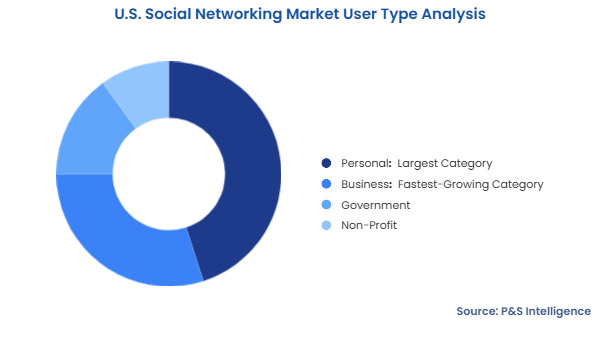
The personal category is the larger, with a share of 45% in 2024. This is because social networking platforms serve as the main communication tool for people who desire to share content and socialize. Some applications, such as Facebook, Instagram, and Snapchat, have huge personal user bases because they connect them to each other, help build relationships, and allow self-expression. People choose diverse network features because they meet their various interests which results in high engagement levels throughout the social media ecosystem. As per studies, around 246 million people in the U.S. actively use social networking websites.
The U.S. social networking market displays the business user type as its faster-developing category, with approx. 10.5% CAGR. Social networking platforms have gained strong business recognition because organizations understand their power to attract customers and build brands while executing marketing initiatives. Through social media platforms, businesses have access to robust tools that help them contact a wide range of individuals, attract specific users, and conduct live communications with their clients.
These are the user types that were analyzed in this report:
- Personal (Largest Category)
- Business (Fastest-Growing Category)
- Government
- Non-Profit
Social Media Platform Analysis
Facebook has the largest share, of 35%, as it is the most-popular social media platform with more than 194 million monthly active users in the country. It features news feeds, groups, events, and marketplaces, which engage individuals as well as businesses. The strong advertising system of Facebook uses user data for precise marketing, which makes it essential for businesses and advertisers to maintain its top market position. Over people in the U.S. regularly use Facebook.
TikTok is the fastest-growing social media network as the creative short clips it features strongly appeal to younger users. TikTok has risen to fame rapidly after its 2016 introduction by attracting primarily young users from the Gen-Z generation because of its innovative video content styles. TikTok has become one of the most-used social apps, with roughly half of U.S. adults now active users and young adults (18–24) spending over an hour daily on the platform. A large majority of teens report monthly use, and the average U.S. user spends around 44 hours per month engaging with its short-form videos.
These are the social media platform types were analyzed:
- Facebook (Largest Category)
- TikTok (Fastest-Growing Category)
Functionality Analysis
Communication is the leading functionality with 30% share. This is because of its versatility, catering to diverse demographics, and features, such as groups, marketplace, and reels that enhance user engagement. More than 200 million businesses are active on Facebook platform and at the same time there is over 7 million advertisers are advertising to their targeted audiences based on their demographics and behaviors.
Marketing is the fastest-growing category because of expanding scope for digital advertisements, development of influencer partnerships, and e-commerce services. Social media platforms have a preferred choice for marketing as they use AI to provide personalized advertisement and interactive buying functionalities to customers. Studies suggest that U.S.-based companies could spend almost USD 80 billion on social media marketing in 2025.
These are the functionalities that were analyzed in this report:
- Communication (Largest Category)
- Entertainment
- Socialization
- Marketing (Fastest-Growing Category)
- Customer Service
Revenue Model Analysis
The advertising category holds the largest share, of 50%. This is due to social networking applications such as Facebook and Instagram making their money through advertising by using massive user data to create tailored advertisement content for their platform. Social media advertising delivers outstanding results since businesses invest huge amounts in funds for advertisement purposes to connect with their desired markets.
Subscription is the fastest-growing revenue model, with approx. 11.5% CAGR. Twitter, LinkedIn, and Snapchat have implemented subscription-based services, which provide special functionalities. Social networking platforms find subscriptions attractive because they create sustained financial income which helps them explore the various ways to earn money.
These are the revenue models studied in this report:
- Advertising (Largest Category)
- Subscription (Fastest-Growing Category)
- Freemium
- Data Monetization
Drive strategic growth with comprehensive market analysis
U.S. Social Networking Market Regional Outlook
The Southern region is the largest and fastest-growing region in the market, with 55% share in 2024, respectively. This dominance is because of the dense urban settlements, rapid adoption of smartphones, and a large population of the young people, who actively use social media. States, such as Texas, Florida, and Georgia, are the key contributors to the market due to their strong broadband infrastructure and extensive mobile phone coverage. Social network platforms are driving business expansion across the South with the integration into small and medium-sized organizations as a platform for marketing and developing customer communities.
These are the regions that were analyzed in this report:
- Northeast
- Midwest
- South (Largest and Fastest-Growing Category)
- West
link


